The Story Map
A framework for story-building
We are all natural-born storytellers. Or at the very least, storylisteners. The same drive lies behind a gathering around the fireplace, a night at the movies or listening to a podcast on your morning run: our brain’s hunger for narratives. Our brains are literally wired for it.
And yet creating a story can be challenging.
This tutorial presents a strategy for simplifying the creative process of building a story. And as in any good story, we have to start from the beginning.
What is a story?
If you ever experienced the so-called “blank page syndrome”, chances are that it originated not from a lack of ideas to write about, but from an overwhelming, chaotic pile of them.
A story, any story, is linear. It doesn’t matter if it is a text, a speech, a movie or even a scientific publication: it will progress from a beginning to an end.
More specifically, any story will be consumed in a linear way. Even a story which content is structured in a non-chronological order has a beginning and an end.
And here comes the challenge: our thoughts are rarely that linear. Most people entertain multiple thoughts simultaneously, or quickly switch from one to the other. It takes a conscious effort to order them into a coherent narrative.
Embracing chaos
Instead of getting frustrated about the chaotic nature of our thoughts, let’s just embrace it. Our thoughts are fine just how they are.
Of course, it is not that practical to have our working memory juggling them all at once. So let’s free our memory and outsource them to… a piece of paper! Just write them down.
My advice is to do it like in the figure below, in small squares, with no pre-defined order. Just drop them around as if they were LEGO bricks.
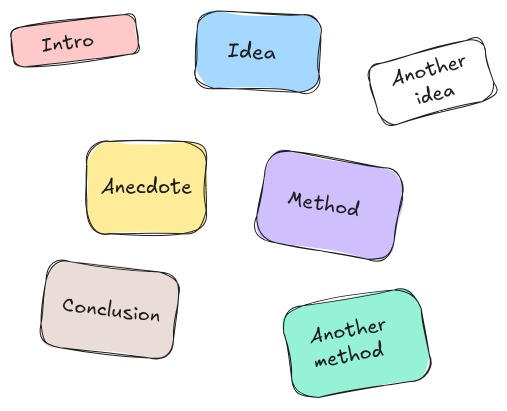
Structuring your thoughts: the building blocks
The challenge is set! Our goal is to build something with these bricks. But first we have to see our bricks, identify them, make sure we’re not missing any. Almost feel them.
Take a moment to look at your building blocks. Very likely, you’ll notice some of them are related. This relationship can be logical, narrative, chronological, … Draw a line between them if that’s the case.
I suggest using solid lines for strong relatedness, and dashed lines for less clear relatedness. We are starting to have some structure! We are slowly creating order out of chaos!
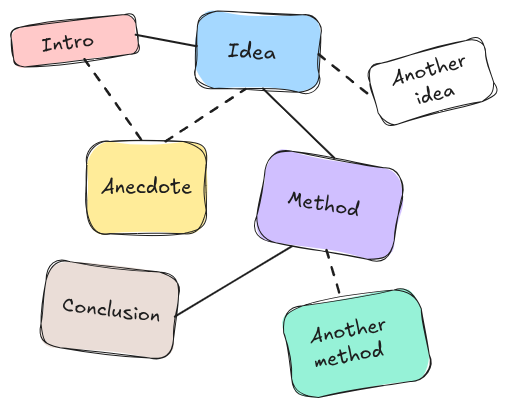
At this stage, you might realize some building blocks are missing. When that’s the case, just add them. You might also notice some building blocks are redundant. Well, just merge those together. You might even judge some of the blocks to be unnecessary. Drop those without hesitation! Nothing creates more order out of chaos than reducing the amount of moving parts!
Navigating your thoughts: the story map
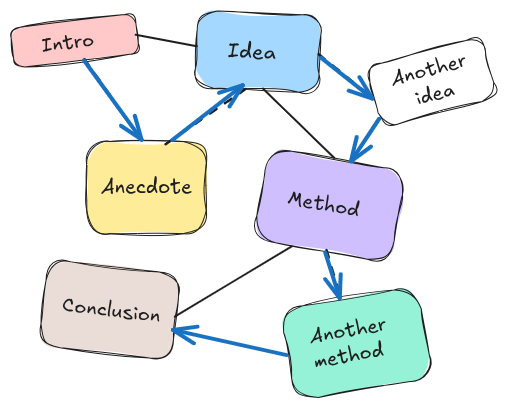
The ultimate goal would be to navigate your thoughts. And I don’t use the verb navigate lightly: you literally want to create a route from the beginning to the end. The diagram above will be very useful for achieving this.
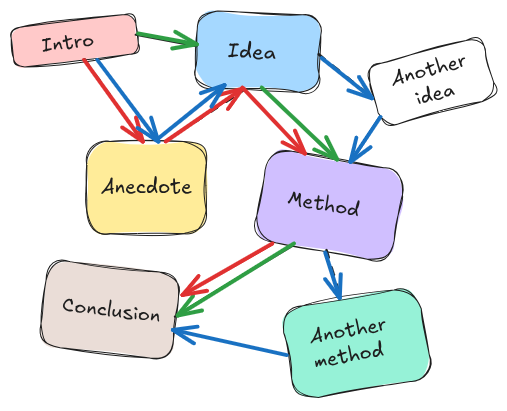
To begin with, the diagram shows clearly what the core topics are. This allows for drawing a first, straightforward route that covers just the basics. If your audience is already knowledgeable about the topic and your time is limited, this route is an excellent choice:
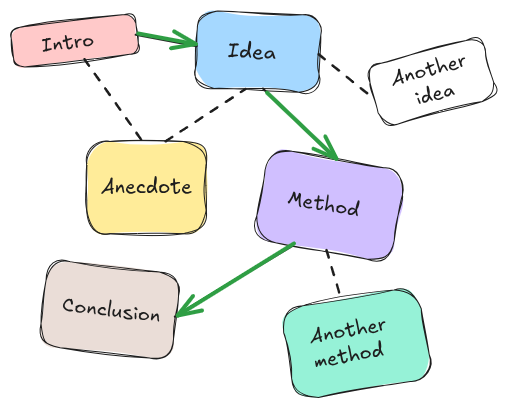
For many people, especially in academia, skipping information feels wrong. In the verge of immoral.
What we did above is tailoring your materials to our audience (sounds better than skipping, doesn’t it?). And yes, we did it by eliminating some of them. Actually, this is going to happen often, and it is very good news. Less complexity, less moving parts; less is more, remember?
Effective communication is not about turning everything that we write or say into a self-contained compendium, but about providing chunks that can be reasonably digested in whatever context they are delivered.
If your time is less limited, you can consider taking a detour and dropping an anecdote to make the experience more enjoyable:
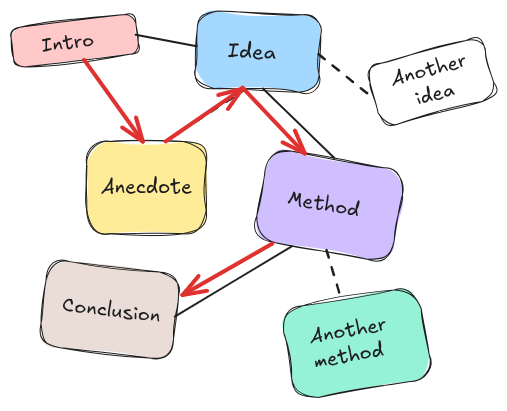
Last but not least, if you have the possibility of expanding as much as you want, you might want to cover all the topics. In such a case, a reasonable route will look like:
In the figure below we summarize three possible routes we could envision for the same material:
Applications
I’ve used the described framework in many settings where storytelling played a role. Perhaps this sounds limited, but believe me: storytelling is everywhere. I used it for, among others:
- Scientific presentations
- Comedy monologues
- Software tutorials
- My own PhD dissertation
- Blog posts
- A strategic plan for a research institution
- Publications in research journals
- A theater play
- And also for this text you are reading now
I honestly encourage you to give it a try next time you face a blank page. It works wonders!
For those interested in knowledge management, this method might remind you of the Zettelkasten note-taking method. Software applications like Logseq or Obsidian are designed with this model in mind.